
TOPCRET – CLAY
Clay plaster in the bathroom: what goes where, from the vanity to the shower
Clay walls are one of the reasons bathrooms have started to look less like a tiled box and more like a room. A matte, warm surface around the vanity, no grout lines to scrub, and a material that takes in some of the steam after a hot shower and lets it go as the room dries.
The question everyone asks is whether clay can handle the water. The honest answer: it depends on which clay and which part of the bathroom. This page goes zone by zone.
In short: traditional clay plaster works on bathroom walls away from water, in a well-ventilated room, but not inside the shower. Clay® Hydro+ is Topcret's clay system for wet zones: it covers splash areas, tub surrounds and shower walls, where it goes over a waterproofing membrane and is sealed, installed by a certified applicator.
Request a quote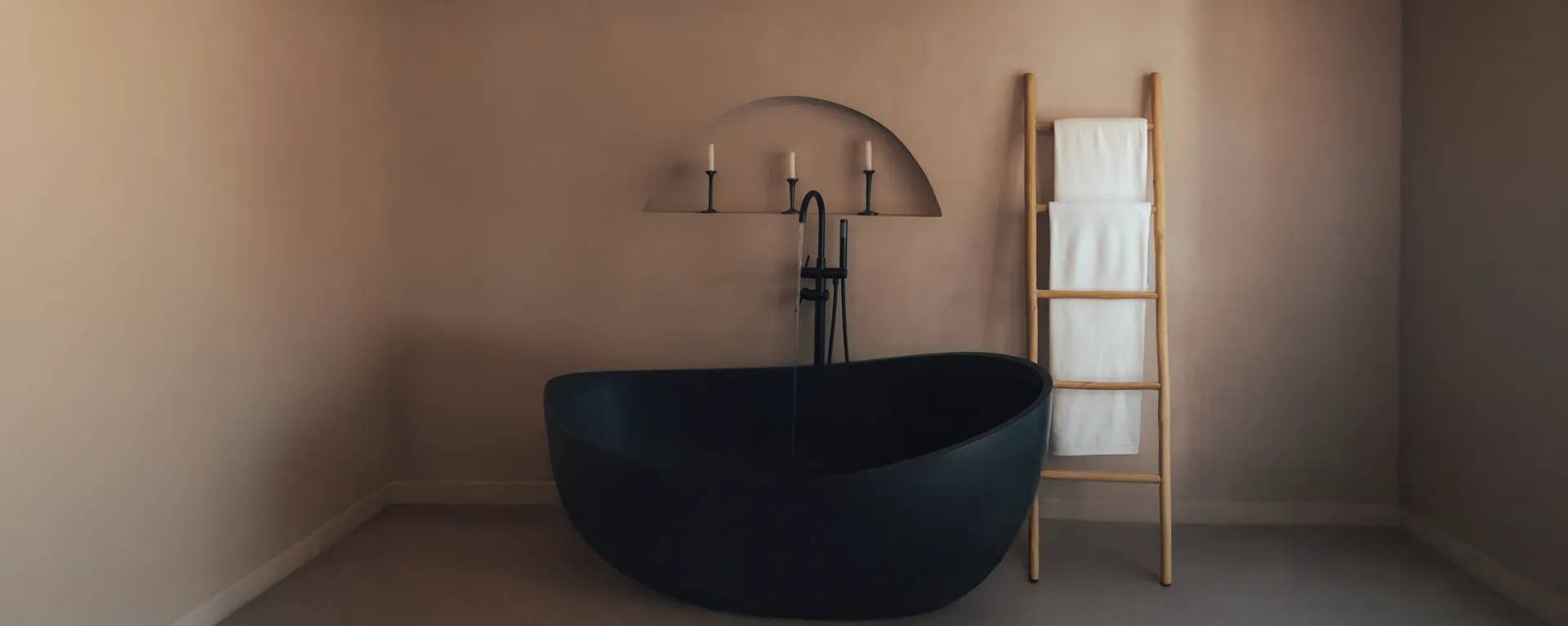
- Dry bathroom walls: Clay® Wall System or Hydro+
- Splash zones and tub surrounds: Clay® Hydro+
- Inside the shower: Clay® Hydro+, over a waterproofing membrane and sealed
- VOC content: VOC-free
- Guarantee: 3 years in writing
Can you use clay plaster in a bathroom?
Yes. Clay plaster has a long history in bathrooms because of the way it handles humidity: its pores absorb moisture from the air and release it as the air dries. That means less water sitting on the wall surface than on a painted wall, which is where mildew usually starts.
What clay does not like is liquid water hitting it again and again. Traditional, natural clay plaster erodes under a shower spray. Its own manufacturers say so: American Clay, the best-known natural clay brand in the US, keeps its earth plaster out of the shower area.
Clay® Hydro+ was developed to close that gap: it is the Clay® system for splash zones and showers. Inside a shower it goes over a waterproofing membrane and is sealed.
Your bathroom, zone by zone
Zone 1: dry walls (away from the vanity and the shower)
The walls behind the toilet, around the door and above head height. Humidity, but no splashing.
- Traditional clay: yes, if the room is ventilated.
- Clay® Wall System: yes.
- Clay® Hydro+: yes, if you want one system for the whole room.
Zone 2: splash areas (vanity wall, tub surround, around the toilet)
Water arrives in drops and splashes, then dries.
- Traditional clay: possible with a sealer, but it is the weak point.
- Clay® Hydro+: yes. This is what it is for.
Zone 3: inside the shower
Direct, repeated water, plus soap and heat.
- Traditional clay: no.
- Clay® Hydro+: yes, over a waterproofing membrane and sealed, as part of a full shower system specified by the applicator.
There is also a code question. Most US jurisdictions follow the International Residential Code, which asks that shower walls, and walls above a tub with a shower head, be finished with a nonabsorbent surface to at least 6 feet above the floor. Your applicator and your local building department are the ones who confirm a finish meets that. The details are in clay plaster showers.
Floors
Clay® is a wall finish. For bathroom floors, microcement can be laid continuous with clay walls.
Which bathroom are you planning?
- Powder room: no shower, little humidity, lots of visual impact. The easiest place for a clay finish, and a good place for a bold texture or a deep color.
- Guest bath with a tub: dry walls in the Wall System or Hydro+, the tub surround in Hydro+.
- Primary bath: usually the full job, from the vanity wall to a walk-in shower. One system (Hydro+) throughout keeps the color and texture identical.
- Kids' bath: lots of splashing and scrubbing. Hydro+ on every wall that gets wet, a medium texture to hide marks.
Ventilation: the part people skip
Clay helps manage humidity; it doesn't remove it. A bathroom with a shower needs a working exhaust fan vented outside, sized to your local code, and the habit of running it during and after a shower. A room that stays above roughly 70% humidity for long periods invites mold on any finish, clay included.
Why clay instead of tile
- No grout. No lines to discolor, no re-grouting.
- Warmer look. Matte and soft instead of glossy and hard.
- No demolition. Clay® goes over sound, primed drywall, so a remodel takes days, not a gut job.
- VOC-free. No solvent smell in a small, closed room.
Tile still wins on one thing: it is the most familiar, cheapest-to-specify solution for a shower floor and for anyone who wants a material their inspector has seen a thousand times.
Clay vs. other bathroom finishes
| Where it works | Maintenance | Look | |
|---|---|---|---|
| Limewash | Dry walls and ceilings | Re-coat over time | Chalky, soft |
| Venetian plaster | Walls, some systems in wet areas | Re-wax or re-seal | Polished, marbled |
| Tadelakt | Showers, if burnished and soaped correctly | Periodic waxing | Satin, organic |
| Microcement | Floors, walls, showers, vanities | Re-seal occasionally | Seamless, mineral |
| Traditional clay plaster | Dry walls only | Gentle cleaning | Matte, earthy |
| Clay® Hydro+ | Walls, splash zones, showers (specified system) | Wipe clean | Matte, earthy, several textures |
If you want the shower floor and the walls to read as one surface, combining a microcement floor with Clay® walls is a common solution. More on microcement in microcement bathrooms.
Textures and colors for bathrooms
Smoother Clay® textures are the easiest to wipe; more textured ones hide water spots and make a statement behind a freestanding tub. Warm sands, soft grays and terracottas are the usual picks next to wood and brass; Paint To Sample matches a custom color. See clay plaster colors and Clay® finishes.
Cleaning and care
- Wipe with a soft cloth or sponge and water; a mild, pH-neutral soap if needed.
- No abrasive pads, bleach or ammonia-based cleaners.
- Squeegee or towel shower walls in hard-water areas to avoid mineral spots.
- Ask your applicator how often the sealer in wet zones should be refreshed.
What a clay bathroom costs
Cost depends on the wall area, the state of the existing surface, how much of the room is a wet zone (Hydro+) and the texture. For a figure for your bathroom, ask for a quote.
FAQs
Is clay plaster good for bathrooms?
Yes, on walls away from direct water in a ventilated room. For splash zones and showers, use a clay system formulated for water such as Clay® Hydro+.
Can clay plaster go in a shower?
Traditional clay plaster can't. Clay® Hydro+ can, over a waterproofing membrane and sealed, as part of a full shower system specified by a certified applicator, and the finish has to meet your local code for shower walls.
Does clay plaster get moldy in a bathroom?
Clay buffers humidity, which reduces condensation on the wall. Mold can still grow on any surface if the room stays very humid, so a working exhaust fan is essential.
How do I clean clay bathroom walls?
With water and a soft cloth, plus a mild pH-neutral soap if needed. Avoid abrasives, bleach and ammonia.
Is clay plaster better than tile in a bathroom?
It is warmer, seamless and grout-free. Tile is more familiar and usually cheaper for shower floors. Many bathrooms combine both, or pair clay walls with a microcement floor.
Is Clay® safe in a small, closed bathroom?
Yes. Clay® is VOC-free, so there is no solvent smell during or after application.
Request a quote
Tell us about your project
A few quick questions and we will get back to you with a tailored proposal.
Email or call us
The quote form needs JavaScript. You can also contact us directly:
A rough figure is fine.
Optional
Where are you based?
Your handle or a link to the profile.
Your contact details
Last step: we will email or call you with our answer.
Please wait a moment…
Preview: the HubSpot form is embedded here. No data is sent in this demo.
We could not load the last step
Email or call us and we will get back to you all the same:
Thank you for your interest
We have received your enquiry. A Topcret advisor will be in touch with you very soon.
Preview complete
This is a demo: no data was sent and nobody will receive this enquiry.
Success Stories
Real projects, real results.







What our clients say
- Topcret helped me doing a repair on my existing floor, and went the distance to get a good result. I would definitely use them againGillian D.★★★★★ (opens in a new tab)
- Jack and the team at Topcret were top-draw. We're beyond pleased with the finished look, but also very impressed with the experience. From our 1st meeting to the aftercare, Topcret were nothing but professional, knowledgable, friendly and flexible. Highly recommend.Sam S.★★★★★ (opens in a new tab)
- Topcret and Juan in particular went above and beyond. Juan worked long days to finish the project as soon as possible, and used his technical knowledge and expertise to problem-solve some of the issues we had with previous tradesmen's mistakes. So happy Topcret could match the paint colour we wanted and that the result is more of an even finish than the typical microcement mix of shades (which they can do as well - we just didn't want that look). Delighted with the result and would definitely use them again. Thank you so much!Isabel D.★★★★★ (opens in a new tab)
- We had our kitchen and bathrooms done in our house in Sydney. The team was very friendly and efficient and the end result was exactly what we wanted. Can’t recommend them enough!Carolina R.★★★★★ (opens in a new tab)
- Topcret’s attention to detail and overall quality of their work is exceptional. I am pleased with the results and would highly recommend Topcret to anyone in need of their services.Rodrigo T.★★★★★ (opens in a new tab)
- Jack has been incredibly helpful in answering all my inquiries since I’ve first visited the showroom. He also made sure that all the technical queries that were put forth from the architects were addressed and proposed solutions to better fit the material. I couldn't be happier, and would recommend 100%.Liza M.★★★★★ (opens in a new tab)
- I recently hired Topcret to finish the renovation on my kitchen and couldn’t be happier with the results. The transformation they've made is just incredible. Provided high quality work with great attention to detail. I would recommend Topcret to anyone looking to make their spaces more attractive!Francesco N.★★★★★ (opens in a new tab)
- Love the product and great customer service. I decided to go for a warm terracotta and Top Cret were very happy to accommodate to develop my own colour.Jacqui P.★★★★★ (opens in a new tab)
- Really happy with the quality of work Topcret have provided for my home. They did 2 Bathrooms, floors and walls which were finished in just 3 days. Jack was extremely helpful throughout the process, answering the many questions I had for him. Great product/ service, I will be recommending to everyone.Tommy J.★★★★★ (opens in a new tab)