
Microcement doors: a seamless finish for flush, barn and pocket doors
In short: yes, microcement can be applied to doors. A certified applicator takes the door off its hinges, primes it, embeds a reinforcing mesh in the first coat and seals it, adding about 2 mm per face. It works best on solid door slabs that don't flex, and it lets a door disappear into a microcement wall.
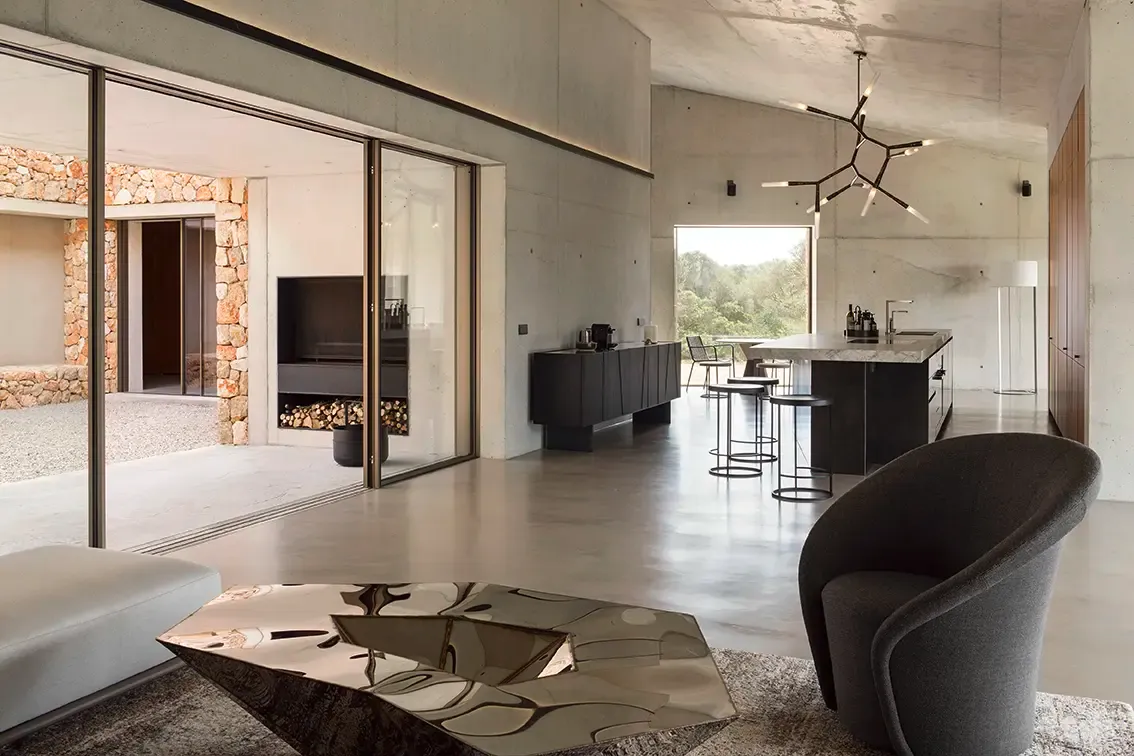
- Added thickness: about 2 mm (0.08 in) per coated face
- Best door slabs: solid wood, solid-core or stable plywood
- Not recommended: hollow-core doors that flex
- Where it shines: flush (hidden) doors, barn doors, pocket doors, closet doors, pivot doors
- Care: a damp cloth and a pH-neutral cleaner
Why put microcement on a door?
Most of the time, microcement is the floor or the wall. On a door, it does something paint or veneer can't: it lets the door take on exactly the same color and texture as the wall around it, so the opening reads as part of the wall rather than as a separate object.
Compared with paint, microcement gives a troweled, mineral surface with movement and depth, not a flat film. Compared with veneer or laminate, there are no edges or seams on the face of the door. Because it goes on in thin coats, it adds almost nothing to the thickness of the door, so proportions and clean lines stay as they are.
Which doors work, and which don't
The door slab matters more than anything else. Microcement is a thin, fairly rigid coating, so it needs a base that stays flat and doesn't flex.
| Door slab | Suitable? | Why |
|---|---|---|
| Solid wood or solid-core | Yes | Stable and heavy enough not to flex when the door is used |
| Plywood | Yes | With a suitable primer and reinforcing mesh, as on Topcret furniture |
| Hollow-core | Not recommended | The thin skins flex when you push or slam the door, which can crack the coating |
| Glass panels | No | Microcement goes on the frame or slab, not on the glass |
Hollow-core interior doors are standard in a lot of American homes. If that is what you have, the usual route is to swap in a solid-core slab and coat that. Your applicator will tell you what is behind the paint before quoting.
Doors that make the most of microcement
Flush and hidden doors
A flush door set in a minimal frame, finished in the same microcement as the wall, almost disappears. It is the most popular use in modern homes, especially for closets, powder rooms and doors off a living area that you'd rather not see.
Barn doors
A sliding barn door is a large flat panel hung in front of the wall, so it is a natural place for texture and color. A textured microcement finish on a barn door gives a mineral, handmade look that pairs well with steel hardware.
Pocket doors
Pocket doors slide into the wall, so clearance matters. Because microcement adds only about 2 mm per face, it usually fits, but your applicator should check the pocket clearance before coating.
Closet and pantry doors
Rows of closet doors or a pantry door in a kitchen can match a microcement kitchen or a microcement wall, so storage blends into the room.
Statement entry and pivot doors
Dark colors like black or charcoal make an entrance. On a large pivot door, a hand-troweled finish has a presence that paint can't match.
How a certified applicator coats a door
The job is closer to finishing a piece of furniture than to coating a floor, and most of it is done off the hinges.
- 01AssessmentThe applicator checks the slab (solid, plywood, hollow), the hinges and the clearance in the frame.
- 02Removal and prepThe door comes off, hardware is removed, and the surface is cleaned and lightly sanded. Paint or varnish that is not sound is taken off.
- 03PrimerA primer suited to the slab creates the bond. On wood and plywood, Topcret uses a suitable primer and a reinforcing mesh, the same approach as on microcement furniture.
- 04CoatsThin base and finish coats are troweled on both faces, with the edges treated so they don't chip.
- 05SealingA sealer protects against stains and handling marks. More on sealers in microcement varnish.
- 06Rehang and checkThe door goes back on and the applicator checks it swings and closes without rubbing.
Colors and pairings
Any of Topcret's base microcement colors can be used on a door. A few combinations that work:
Homes and commercial spaces
In homes, microcement doors give continuity between rooms, especially in open-plan layouts where a painted door would break the wall. In stores, restaurants and hotels, they let back-of-house and restroom doors blend into a branded wall finish, and the sealed surface stands up to a lot of hands.
Care and maintenance
Clean with a soft, damp cloth and a pH-neutral cleaner.
Avoid scouring pads, solvents and harsh chemicals, which damage the sealer.
Use a door stop or bumper so the handle doesn't hit the wall.
Around the handle, where hands touch most, the sealer is what wears first; re-sealing brings it back. Chips on edges can be repaired locally: see microcement repair.
What it costs
Doors are usually most cost-effective when they are coated as part of a larger job, such as walls or floors in the same room. For wall and floor prices, see how much microcement costs; for your doors, ask for a quote.
Frequently asked questions
Can you put microcement on a door?
Yes, on doors that don't flex: solid wood, solid-core or stable plywood. The applicator primes the door, embeds a mesh in the first coat and seals it.
Can microcement go on a hollow-core door?
It isn't recommended. Hollow-core doors flex when they are pushed or slammed, and that movement can crack a thin coating. Replacing the slab with a solid-core door is the usual fix.
Will my door still close after coating?
In most cases, yes. Microcement adds about 2 mm per face. The applicator checks the gap in the frame, and for pocket doors the clearance inside the wall, before starting.
Is a microcement door heavy?
The coating adds very little weight compared with the door itself. On large pivot or barn doors, the hardware should already be rated for the slab.
How do you clean a microcement door?
With a damp cloth and a pH-neutral cleaner. No scouring pads, bleach or solvents.
Request a quote
Tell us about your project
A few quick questions and we will get back to you with a tailored proposal.
Email or call us
The quote form needs JavaScript. You can also contact us directly:
A rough figure is fine.
Optional
Where are you based?
Your handle or a link to the profile.
Your contact details
Last step: we will email or call you with our answer.
Please wait a moment…
Preview: the HubSpot form is embedded here. No data is sent in this demo.
We could not load the last step
Email or call us and we will get back to you all the same:
Thank you for your interest
We have received your enquiry. A Topcret advisor will be in touch with you very soon.
Preview complete
This is a demo: no data was sent and nobody will receive this enquiry.
Discover our Colours
Our colourist experts developed more than 30 base colours to fulfill a wide range of applications. But we don’t want to limit your imagination, so we created Paint To Sample, a Topcret® innovation powered by your imagination, to offer high-end, enhanced personalisation for customers.
Our ISO certification process assures zero colour deviations, so what our client dreamed is what they will see installed in their project.
- Over 30 base colours available
- Colour on demand
- Finishes in several textures
In today’s world our connection with nature holds immense importance, and it is this bond that inspires our colours.
Application process
Surface preparation
Clean, dry and free of dust or grease. Any existing damage is repaired to guarantee a smooth surface.
Primer application
It creates an ideal bonding surface and can be tinted to match the colour of the microcement.
Mixing
It is mixed with water and the chosen pigments until the colour and texture are right.
First coat
Applied in a thin layer, left to dry before the second application.
Second coat
Slightly thicker than the first, this is the one that creates the texture and the finish.
Sealing and finishing
A sealer protects the surface from stains and damage; a finishing wax or oil sets the final look.
Success Stories
Real projects, real results.










What our clients say
- Topcret helped me doing a repair on my existing floor, and went the distance to get a good result. I would definitely use them againGillian D.★★★★★ (opens in a new tab)
- Jack and the team at Topcret were top-draw. We're beyond pleased with the finished look, but also very impressed with the experience. From our 1st meeting to the aftercare, Topcret were nothing but professional, knowledgable, friendly and flexible. Highly recommend.Sam S.★★★★★ (opens in a new tab)
- Topcret and Juan in particular went above and beyond. Juan worked long days to finish the project as soon as possible, and used his technical knowledge and expertise to problem-solve some of the issues we had with previous tradesmen's mistakes. So happy Topcret could match the paint colour we wanted and that the result is more of an even finish than the typical microcement mix of shades (which they can do as well - we just didn't want that look). Delighted with the result and would definitely use them again. Thank you so much!Isabel D.★★★★★ (opens in a new tab)
- We had our kitchen and bathrooms done in our house in Sydney. The team was very friendly and efficient and the end result was exactly what we wanted. Can’t recommend them enough!Carolina R.★★★★★ (opens in a new tab)
- Topcret’s attention to detail and overall quality of their work is exceptional. I am pleased with the results and would highly recommend Topcret to anyone in need of their services.Rodrigo T.★★★★★ (opens in a new tab)
- Jack has been incredibly helpful in answering all my inquiries since I’ve first visited the showroom. He also made sure that all the technical queries that were put forth from the architects were addressed and proposed solutions to better fit the material. I couldn't be happier, and would recommend 100%.Liza M.★★★★★ (opens in a new tab)
- I recently hired Topcret to finish the renovation on my kitchen and couldn’t be happier with the results. The transformation they've made is just incredible. Provided high quality work with great attention to detail. I would recommend Topcret to anyone looking to make their spaces more attractive!Francesco N.★★★★★ (opens in a new tab)
- Love the product and great customer service. I decided to go for a warm terracotta and Top Cret were very happy to accommodate to develop my own colour.Jacqui P.★★★★★ (opens in a new tab)
- Really happy with the quality of work Topcret have provided for my home. They did 2 Bathrooms, floors and walls which were finished in just 3 days. Jack was extremely helpful throughout the process, answering the many questions I had for him. Great product/ service, I will be recommending to everyone.Tommy J.★★★★★ (opens in a new tab)