
Clay plaster showers: how clay works in a wet area
A shower finished in clay feels like nothing else: warm, matte and seamless, with no grout lines to scrub. For a long time it simply wasn't possible, because ordinary clay softens when it gets wet. A clay finish built for wet areas changes that, as long as the shower underneath is built properly.
This page explains why ordinary clay plaster can't go in a shower, how Clay® Hydro+ is different, what has to sit behind it in an Australian bathroom, and how to look after it.
In short: ordinary clay plaster is not suitable for showers, because it softens with water. Clay® Hydro+ by Topcret is formulated for wet areas. In an Australian shower it goes on top of a waterproofing membrane that complies with AS 3740, installed first, and it is sealed. The membrane keeps water out; the clay is the finish.
Request a quote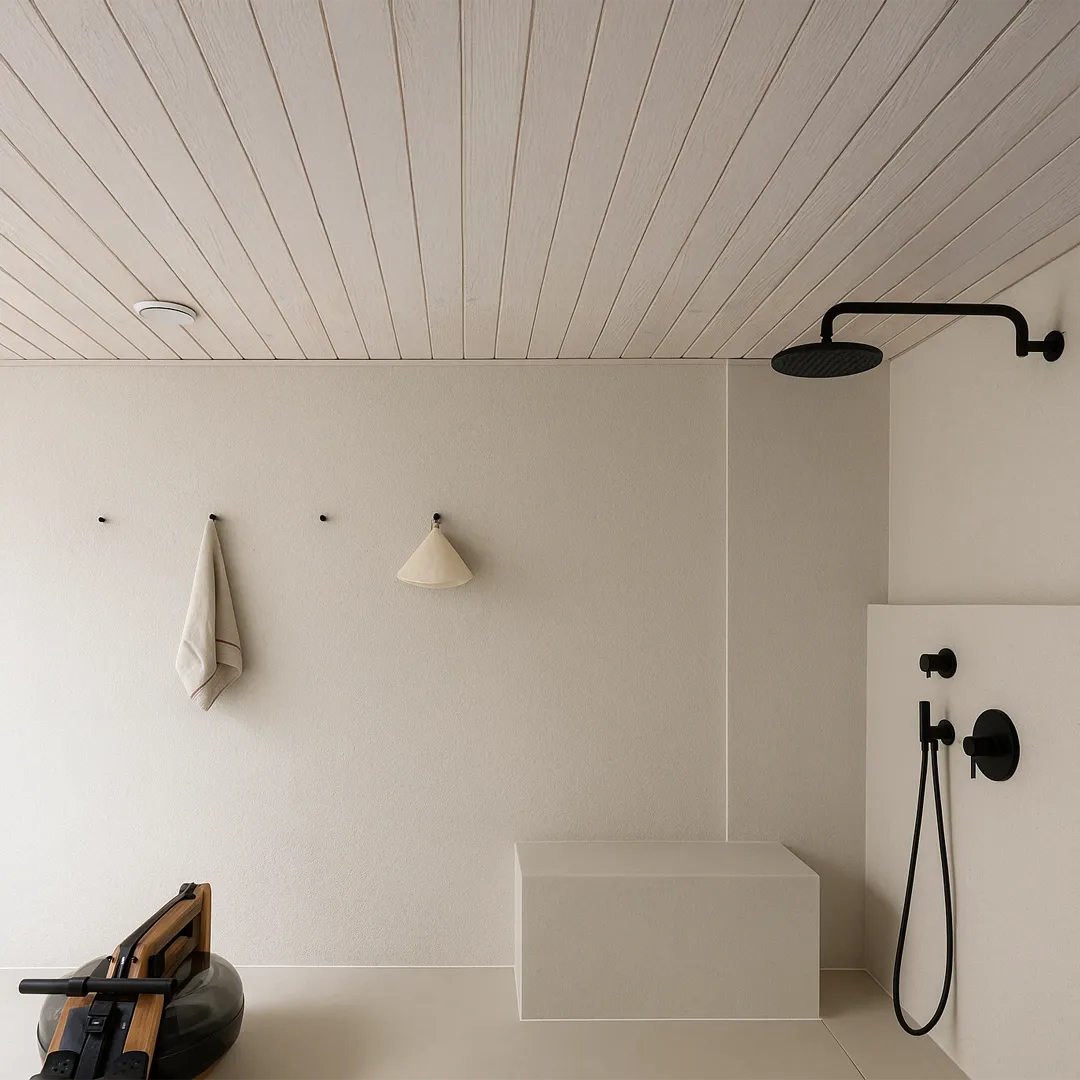
- System: Clay® Hydro+
- Behind it: waterproofing membrane to AS 3740, by the waterproofer
- Sealer: always, in a shower
- Walls: yes · Niches and benches: yes
- Best textures: smoother ones, the easiest to wipe
- Installed by: certified Topcret applicators, three-year written guarantee
Why ordinary clay plaster can't go in a shower
Traditional clay plasters are breathable and beautiful, but in constant contact with water:
- they absorb water and soften,
- they can swell, erode or crack,
- and they need constant upkeep to survive.
That is why other makers state that their clay finishes are fine in a bathroom but not inside the shower.
What makes Clay® Hydro+ different
Clay® comes in two systems. The Wall system is for dry rooms. Hydro+ is formulated for wet areas and keeps the matte, natural look of clay. It lets one finish run from the bathroom walls into the shower without a change of material.
What it is not: a waterproofing membrane. In Australia, that is a separate layer with its own standard.
What goes behind a clay shower in Australia
Every shower in an Australian home has to be waterproofed under the National Construction Code and AS 3740, Waterproofing of domestic wet areas. In several states, including New South Wales and Queensland, waterproofing is licensed work. The layers, from the wall out, are:
- Wall lining suited to wet areas: fibre cement sheet, wet-area plasterboard or render.
- Waterproofing membrane to AS 3740, applied by the waterproofer, with the corners, joints, penetrations and the floor-to-wall junction treated.
- Clay® Hydro+, base coat and finish coat, by the certified Topcret applicator.
- Sealer, which in a shower is always applied.
Get your builder, waterproofer and Topcret applicator talking before work starts, so the membrane and the clay are compatible and the order is right.
Walls, niches and benches
- Walls: the main use. One colour and texture from the vanity wall into the shower.
- Niches: clay wraps into a recessed niche with no grout lines, so there is nowhere for soap scum to collect. The bottom of the niche needs a slight fall so water doesn't sit.
- Built-in benches: the bench is waterproofed like the rest of the shower, then finished in clay.
The shower floor
Clay® goes on the shower walls. For the floor, a microcement shower with a non-slip finish keeps the seamless look; tiles are the other option. A wet floor needs grip: in Australia, slip resistance is measured with the wet pendulum test under AS 4586 and expressed as a P rating, so ask for the rating of whatever goes on your shower floor.
Hard water and everyday care
- Squeegee the walls after each shower: it takes seconds and prevents marks.
- In hard-water areas (much of Adelaide and Perth, and many regional towns), wipe off limescale before it builds up.
- Clean with water and a pH-neutral cleaner and a soft cloth.
- Avoid bleach, ammonia, acidic descalers and abrasive pads, which damage the surface and the sealer.
- Ventilate: run the exhaust fan during and after the shower.
Design ideas
- Walk-in showers with a fixed glass panel show off a continuous clay wall best.
- Pair with timber (a slatted bench or vanity), natural stone or brushed brass tapware.
- Warm sands and nudes feel spa-like; olives and charcoals look crisp against white fittings.
- Soft, low lighting brings out the texture.
When clay is not the right choice
- If you want a shower that needs no care at all: any finish needs squeegeeing and the occasional reseal, and clay is no exception.
- If the shower can't be waterproofed properly underneath.
FAQs
Can you use clay plaster in a shower?
Ordinary clay plaster, no. Clay® Hydro+, yes, on the walls, on top of a waterproofing membrane that complies with AS 3740, and sealed.
Is clay plaster waterproof?
Ordinary clay isn't. In a shower, the waterproofing is the membrane underneath; Clay® Hydro+ is the finish on top, and it is sealed.
Do I still need a waterproofing membrane?
Yes. Every Australian shower needs one under the NCC and AS 3740, whatever the finish.
Is a clay shower slippery?
Clay® goes on the shower walls. For the floor, ask for the slip rating (P rating to AS 4586) of the finish.
How do I clean a clay shower?
Squeegee after use, clean with a pH-neutral product and a soft cloth, and avoid bleach and acidic descalers.
Request a quote
Tell us about your project
A few quick questions and we will get back to you with a tailored proposal.
Email or call us
The quote form needs JavaScript. You can also contact us directly:
A rough figure is fine.
Optional
Where are you based?
Your handle or a link to the profile.
Your contact details
Last step: we will email or call you with our answer.
Please wait a moment…
Preview: the HubSpot form is embedded here. No data is sent in this demo.
We could not load the last step
Email or call us and we will get back to you all the same:
Thank you for your interest
We have received your enquiry. A Topcret advisor will be in touch with you very soon.
Preview complete
This is a demo: no data was sent and nobody will receive this enquiry.
Success Stories
Real projects, real results.






What our clients say
- Topcret helped me doing a repair on my existing floor, and went the distance to get a good result. I would definitely use them againGillian D.★★★★★ (opens in a new tab)
- Jack and the team at Topcret were top-draw. We're beyond pleased with the finished look, but also very impressed with the experience. From our 1st meeting to the aftercare, Topcret were nothing but professional, knowledgable, friendly and flexible. Highly recommend.Sam S.★★★★★ (opens in a new tab)
- Topcret and Juan in particular went above and beyond. Juan worked long days to finish the project as soon as possible, and used his technical knowledge and expertise to problem-solve some of the issues we had with previous tradesmen's mistakes. So happy Topcret could match the paint colour we wanted and that the result is more of an even finish than the typical microcement mix of shades (which they can do as well - we just didn't want that look). Delighted with the result and would definitely use them again. Thank you so much!Isabel D.★★★★★ (opens in a new tab)
- We had our kitchen and bathrooms done in our house in Sydney. The team was very friendly and efficient and the end result was exactly what we wanted. Can’t recommend them enough!Carolina R.★★★★★ (opens in a new tab)
- Topcret’s attention to detail and overall quality of their work is exceptional. I am pleased with the results and would highly recommend Topcret to anyone in need of their services.Rodrigo T.★★★★★ (opens in a new tab)
- Jack has been incredibly helpful in answering all my inquiries since I’ve first visited the showroom. He also made sure that all the technical queries that were put forth from the architects were addressed and proposed solutions to better fit the material. I couldn't be happier, and would recommend 100%.Liza M.★★★★★ (opens in a new tab)
- I recently hired Topcret to finish the renovation on my kitchen and couldn’t be happier with the results. The transformation they've made is just incredible. Provided high quality work with great attention to detail. I would recommend Topcret to anyone looking to make their spaces more attractive!Francesco N.★★★★★ (opens in a new tab)
- Love the product and great customer service. I decided to go for a warm terracotta and Top Cret were very happy to accommodate to develop my own colour.Jacqui P.★★★★★ (opens in a new tab)
- Really happy with the quality of work Topcret have provided for my home. They did 2 Bathrooms, floors and walls which were finished in just 3 days. Jack was extremely helpful throughout the process, answering the many questions I had for him. Great product/ service, I will be recommending to everyone.Tommy J.★★★★★ (opens in a new tab)