
Natural clay plaster for interior walls in Australian homes
Clay is one of the oldest wall finishes there is, and one of the few that still feels right in a modern home. A natural clay plaster wall is matte, soft to the touch and slightly uneven in a way paint never is. It changes with the light through the day, and it helps a room cope with humidity rather than trapping it.
This page explains what natural clay plaster is made of, what it does well and where it falls short, how Topcret's Clay® deals with those limits, and where it works inside an Australian home.
In short: natural clay plaster is a wall finish made from clay, fine sand and mineral fillers, trowelled on in thin coats. It is breathable, VOC-free and matte. Traditional clay marks easily and stays out of wet areas; Topcret's Clay® comes pre-blended in two systems, Wall for dry rooms and Hydro+ for bathrooms and kitchens.
Request a quote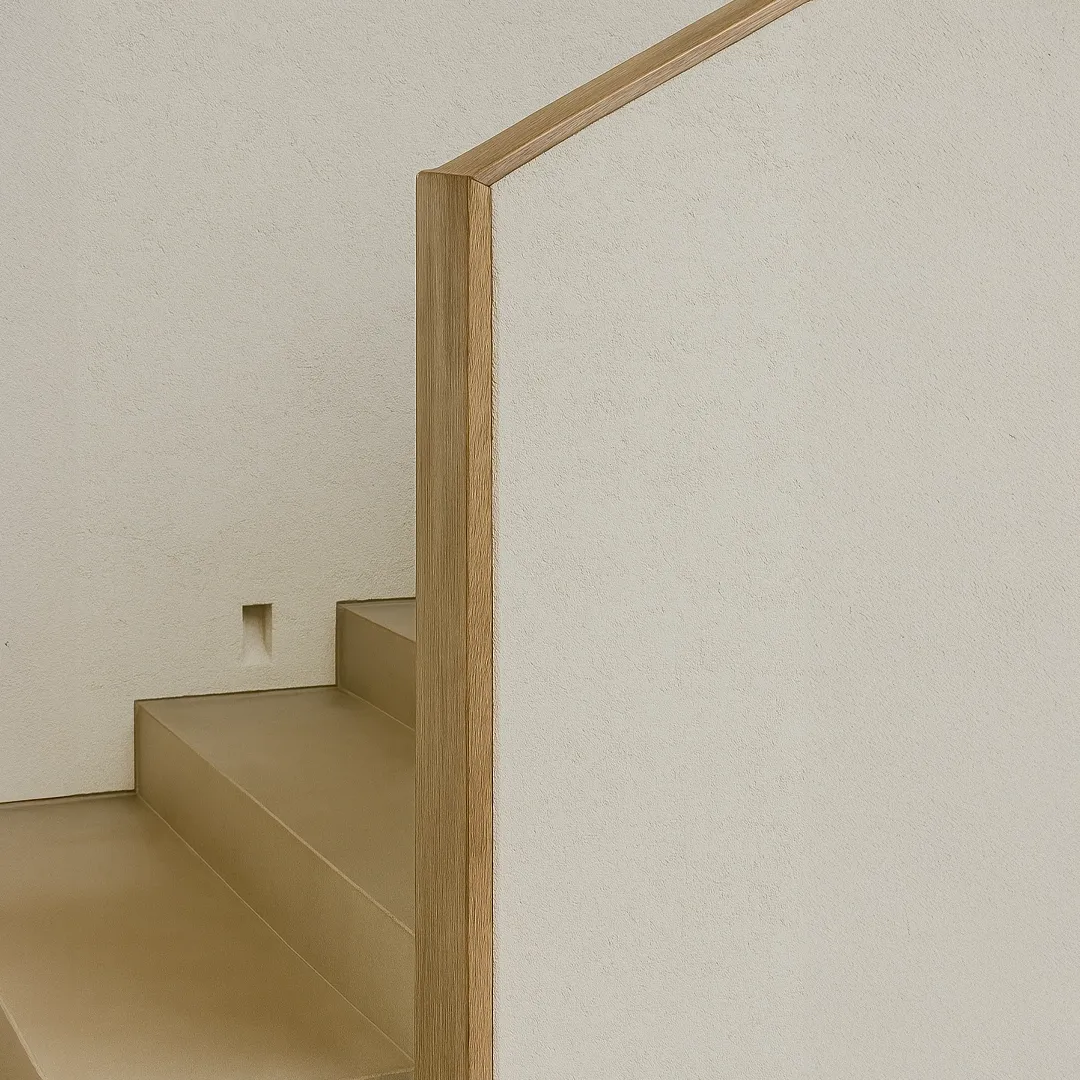
- What it is: clay, sand and mineral fillers, pre-blended
- Thickness: typically 2–10 mm, depending on texture
- Textures: from smooth to rustic
- Systems: Wall (dry interiors) and Hydro+ (humid rooms)
- Installed by: certified Topcret applicators, with a three-year written guarantee
What natural clay plaster is made of
A traditional clay plaster, or clay render as many Australian tradies call it, is a mix of clay, sand and sometimes straw or other fibres. The clay is the binder: it holds the sand together and sticks to the wall without cement, gypsum or acrylic resins. That is why it stays breathable and why it has no solvents to give off.
Clay® by Topcret keeps that base of clay, minerals and fine aggregates, but it arrives pre-blended. The applicator doesn't have to dig, sieve or measure, and each batch behaves the same as the last, which matters when a wall is finished over two days or a project runs across several rooms.
Why choose clay plaster for interior walls
It handles humidity instead of trapping it
Clay absorbs moisture from the air when the room is humid and gives it back when the air dries out. In a Brisbane or Sydney summer that means less of the clammy feel on the walls; in a Perth or Adelaide home where reverse-cycle air conditioning dries the air for months, it helps the room feel less parched. It is a buffer, not a dehumidifier, and good ventilation still matters.
It keeps solvents out of the air you breathe
Clay® is VOC-free and solvent-free. For bedrooms, nurseries and homes where someone has asthma or allergies, a wall that gives off nothing after it dries is a real difference from many paints and synthetic coatings.
It looks and feels different from paint
Paint sits on top of the wall as a film. Clay holds its pigment through the whole coat, so the colour has depth, and the matte, slightly uneven surface diffuses light softly. Under the strong, low sun of an Australian winter afternoon, a clay wall shows its texture; under warm evening lighting it reads calm and soft.
The downsides of traditional clay plaster, and how Clay® answers them
Clay has limits, and it is better to know them before you choose it.
- It marks and dusts. Unsealed traditional clay can rub off on clothes and scuff when furniture knocks it. Clay® is formulated to be harder-wearing and can be sealed in high-use areas.
- It doesn't like water. Traditional clay softens when it gets wet, which is why it has always stayed out of bathrooms and splashbacks. Clay® Hydro+ is the system made for humid rooms (more below).
- It needs a sound, absorbent base. Clay won't hide a moving or cracked wall. The substrate is checked and primed first.
Two systems: Wall and Hydro+
| Wall system | Hydro+ system | |
|---|---|---|
| Where | Living rooms, bedrooms, hallways, offices | Bathrooms, ensuites, laundries, kitchen splashbacks |
| Character | Breathable, matte, natural | Formulated for humid rooms |
| Sealer | Optional; recommended where walls get touched or knocked | Optional for extra protection; always applied in a shower |
| In a shower | No | Yes, on the walls, over a waterproofing membrane that complies with AS 3740, and sealed |
In any Australian wet area, the waterproofing behind the finish is a separate job governed by the National Construction Code and AS 3740. Clay® Hydro+ is the finish that goes on top, not a replacement for the membrane. More in clay plaster showers (nueva) and clay plaster bathrooms.
Where natural clay plaster works inside the home
Living rooms and open-plan areas
On a long open-plan wall, a clay finish brings warmth without pattern. A smooth or softly textured finish keeps it quiet; a feature wall behind the lounge can take a layered texture.
Bedrooms
Clay is at its best in bedrooms: soft light, no smell, and a surface that feels calm. Pale, warm neutrals in a smooth finish are the usual choice.
Hallways and entries
Entries take knocks from bags, prams and bikes, so they are where a sealer earns its keep. A textured finish also hides small marks better than a smooth one.
Ceilings
Clay can carry on from the wall onto the ceiling, which removes the line where two finishes meet. See clay plaster ceilings (nueva).
Kitchens and bathrooms
With Hydro+, clay can go on bathroom walls, ensuites and splashbacks. It is not made for benchtops. See clay plaster kitchens (nueva).
What it goes over
Clay® can be applied over plasterboard, fibre cement sheet, and cement or lime render, after priming. Any other surface is assessed by the applicator on the site visit. Older homes, from federation houses to post-war brick veneer, often have walls that need patching before any fine finish; your applicator will check that on the site visit.
Textures and colours
Clay® can be trowelled from a flat, velvety finish to a bold, rustic relief, and each texture changes how a colour reads, so pick them together. More in clay plaster finishes (nueva) and clay plaster colours (nueva).
How you get clay walls with Topcret
- Site visit. A technician checks the walls and recommends the system.
- Quote. Every item is set out in writing.
- Application. A Topcret-certified applicator primes, applies the base coat and the finishing coat by hand.
- Inspection. The finished wall is checked with you, and the work carries Topcret's three-year written guarantee.
Topcret, founded in Barcelona in 2005, manufactures its own coatings under ISO 9001.
FAQs
Is natural clay plaster good for walls?
Yes, in the right rooms. It is breathable, VOC-free and handsome, and it buffers humidity. Traditional clay is soft and dislikes water; a pre-blended system such as Clay® is harder-wearing and has a version for humid rooms.
What are the disadvantages of clay plaster?
Traditional clay can dust, scuff and soften with water, and it needs a sound base. Sealing high-touch areas and using the Hydro+ system in humid rooms deal with most of that.
How long does clay plaster last?
On a sound wall, decades. Clay is one of the longest-lived wall finishes in old buildings, and small marks can be repaired locally rather than redoing the whole wall.
Is clay plaster the same as clay render?
In Australia the two words are used for the same kind of finish. «Render» usually means a thicker coat, often outdoors; «plaster» a thinner interior finish.
Can clay plaster go in a bathroom?
Traditional clay, no. Clay® Hydro+, yes, on bathroom walls and on shower walls, over a compliant waterproofing membrane and sealed.
Can I apply it myself?
Topcret installs Clay® only through certified applicators, which is what the written guarantee depends on.
Request a quote
Tell us about your project
A few quick questions and we will get back to you with a tailored proposal.
Email or call us
The quote form needs JavaScript. You can also contact us directly:
A rough figure is fine.
Optional
Where are you based?
Your handle or a link to the profile.
Your contact details
Last step: we will email or call you with our answer.
Please wait a moment…
Preview: the HubSpot form is embedded here. No data is sent in this demo.
We could not load the last step
Email or call us and we will get back to you all the same:
Thank you for your interest
We have received your enquiry. A Topcret advisor will be in touch with you very soon.
Preview complete
This is a demo: no data was sent and nobody will receive this enquiry.
Success Stories
Real projects, real results.






What our clients say
- Topcret helped me doing a repair on my existing floor, and went the distance to get a good result. I would definitely use them againGillian D.★★★★★ (opens in a new tab)
- Jack and the team at Topcret were top-draw. We're beyond pleased with the finished look, but also very impressed with the experience. From our 1st meeting to the aftercare, Topcret were nothing but professional, knowledgable, friendly and flexible. Highly recommend.Sam S.★★★★★ (opens in a new tab)
- Topcret and Juan in particular went above and beyond. Juan worked long days to finish the project as soon as possible, and used his technical knowledge and expertise to problem-solve some of the issues we had with previous tradesmen's mistakes. So happy Topcret could match the paint colour we wanted and that the result is more of an even finish than the typical microcement mix of shades (which they can do as well - we just didn't want that look). Delighted with the result and would definitely use them again. Thank you so much!Isabel D.★★★★★ (opens in a new tab)
- We had our kitchen and bathrooms done in our house in Sydney. The team was very friendly and efficient and the end result was exactly what we wanted. Can’t recommend them enough!Carolina R.★★★★★ (opens in a new tab)
- Topcret’s attention to detail and overall quality of their work is exceptional. I am pleased with the results and would highly recommend Topcret to anyone in need of their services.Rodrigo T.★★★★★ (opens in a new tab)
- Jack has been incredibly helpful in answering all my inquiries since I’ve first visited the showroom. He also made sure that all the technical queries that were put forth from the architects were addressed and proposed solutions to better fit the material. I couldn't be happier, and would recommend 100%.Liza M.★★★★★ (opens in a new tab)
- I recently hired Topcret to finish the renovation on my kitchen and couldn’t be happier with the results. The transformation they've made is just incredible. Provided high quality work with great attention to detail. I would recommend Topcret to anyone looking to make their spaces more attractive!Francesco N.★★★★★ (opens in a new tab)
- Love the product and great customer service. I decided to go for a warm terracotta and Top Cret were very happy to accommodate to develop my own colour.Jacqui P.★★★★★ (opens in a new tab)
- Really happy with the quality of work Topcret have provided for my home. They did 2 Bathrooms, floors and walls which were finished in just 3 days. Jack was extremely helpful throughout the process, answering the many questions I had for him. Great product/ service, I will be recommending to everyone.Tommy J.★★★★★ (opens in a new tab)