
TOPCRET – CLAY
Interior Clay Plaster: Uses, Finishes, and Benefits
Clay plaster is one of the oldest wall finishes there is, and it is back in British homes for practical reasons as much as looks. A clay wall is matte and soft to the eye. It takes in moisture when a room is damp and gives it back when the air dries. And it adds no solvents to the air you breathe.
This guide is about using it inside: which rooms and surfaces suit it, which walls it can go over, how to choose a finish, and what to expect from a project with Clay®, Topcret's clay wall finish.
Request a quote
In short: interior clay plaster is a thin, trowel-applied wall finish made from clay, sand and fine minerals. It is breathable, matte and VOC free. It suits living rooms, bedrooms, hallways and ceilings. With Clay®, bathrooms use the Hydro+ system, and showers always go over a waterproofing membrane and are sealed.
- Rooms: living areas, bedrooms, hallways, ceilings; bathrooms and kitchen walls with Hydro+
- Walls: plasterboard, sound existing plaster, lime render, cement board
- Finish: always matte, from smooth to textured
What interior clay plaster is
Clay plaster uses clay as the binder, mixed with sand and fine mineral aggregates. On interior walls it goes on in thin coats with a steel trowel, and the last pass decides the finish. It is coloured in the mix, so the colour runs through the material instead of sitting on top as a film of paint.
The traditional version is mixed on site in several coats. It works well on dry walls, but the result depends on the hand that mixes it, and it does not take water. Clay® keeps the same idea with two changes:
- It comes pre-mixed, so colour and texture stay consistent from one wall to the next.
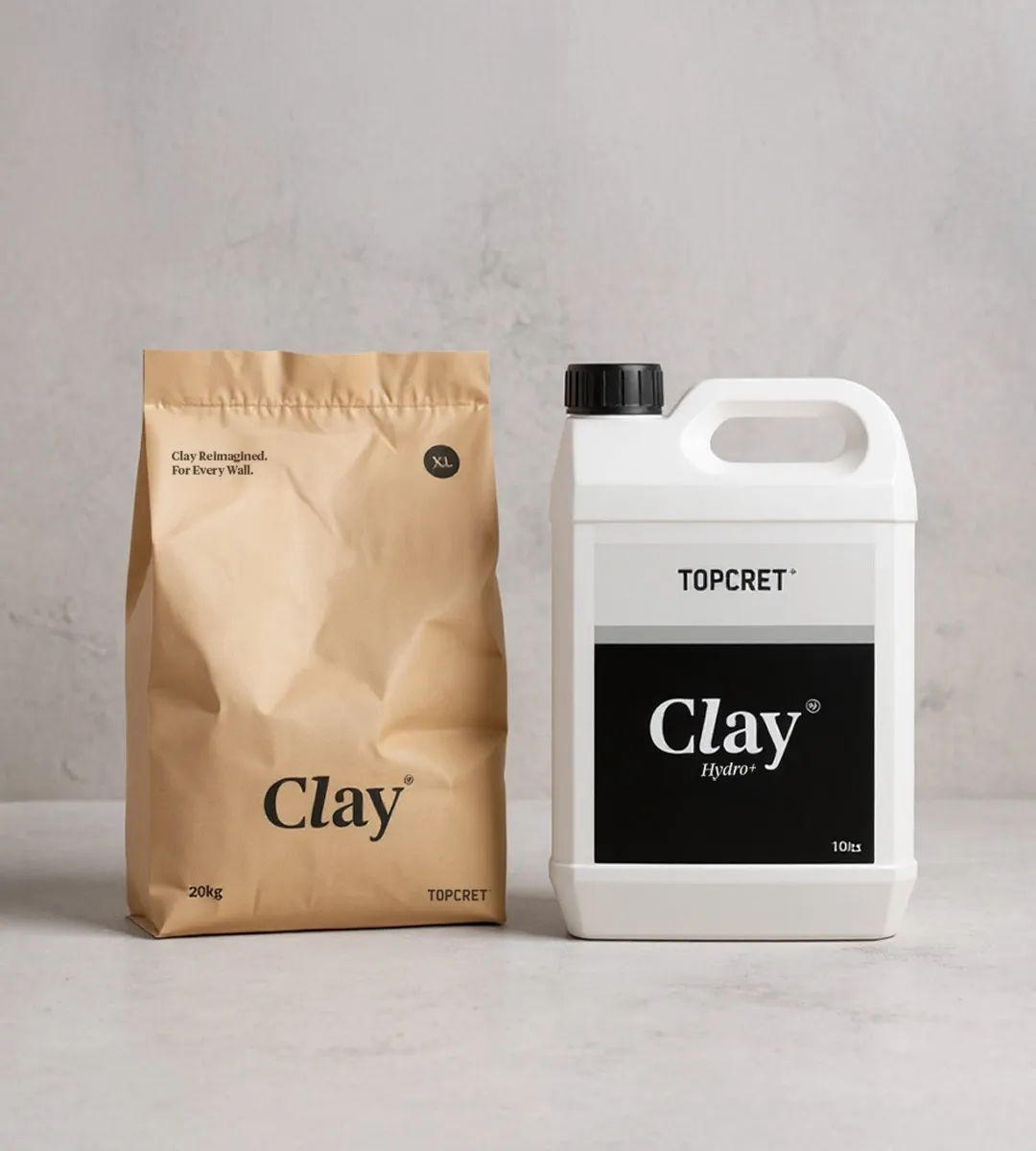
- It has two systems. Clay® Wall is the breathable finish for dry rooms. Clay® Hydro+ is formulated for bathrooms and other humid rooms.
Topcret also made Clay® tougher than traditional clay. It stands up to daily use without cracking or dusting, which is what held clay finishes back in busy homes.
More on the material, and how it compares with lime and gypsum, in natural clay plaster.
Where to use clay plaster inside the home
Living rooms and open-plan spaces
This is where clay plaster is most at home. Large walls show off the slight variation in tone, and the matte surface keeps light soft rather than glary. A single feature wall works too, behind a sofa or around a fireplace breast, if you'd rather not do the whole room.
Bedrooms
Bedrooms are where moisture buffering pays off. Overnight, a closed bedroom builds up humidity, and in a lot of British homes that shows as condensation on cold walls and windows by morning. A clay wall takes in some of that moisture and releases it as the room airs. It is not a substitute for ventilation, but it helps even out the swings.
Hallways, landings and stairs
These walls get touched, brushed by bags and scuffed by shoes. Clay® is made for daily use, and a sealer on the lower part of the wall makes marks easier to wipe. A smoother finish is easier to keep clean than a heavy texture at hand height.
Ceilings
A clay ceiling gives the room a soft, even surface overhead, without the plastic sheen some ceiling paints have. On a ceiling, the work is mainly about the base: it has to be sound and well fixed before any coat goes on. More in clay plaster ceilings.
Bathrooms and kitchens
This is the main difference between Clay® and a traditional clay plaster. Most clay plasters are not suitable where water runs or stands: showers, wet rooms, the wall behind a basin. Clay® uses its Hydro+ system in bathrooms. Inside a shower it always goes over a waterproofing membrane and is sealed. The membrane keeps water out of the wall; the clay finish goes on top of it, not instead of it.
In kitchens, clay suits the walls, the splashback and the chimney breast. It does not suit worktops: a working surface needs a harder material, such as microcement.
Room-by-room detail in clay plaster bathrooms, clay plaster showers and clay plaster kitchens.
Hotels, restaurants and wellness spaces
Commercial interiors use clay for the same reasons homes do: warmth, a natural look and a calmer feel. In public areas, plan for wear. Use a sealer where people lean or brush past, and choose the Hydro+ system in washrooms and spa areas.
Which walls it goes over
Clay® goes over most stable, absorbent interior surfaces:
- Plasterboard, the norm in new builds, extensions and stud walls.
- Sound existing plaster, including gypsum skim on older walls, as long as it is dry and well bonded.
- Lime render, common in period properties.
- Cement board, typically in bathrooms.
For anything else, ask the applicator before you plan the work. In most renovations this means the walls don't need to be stripped back to brick. The applicator checks the base, repairs or levels it if needed, and applies the right primer first.
Period homes with solid walls
Many older British houses have solid brick or stone walls that were built to let moisture move through them. Covering them in plastic paints or impermeable coatings can trap that moisture. A breathable clay finish keeps the wall able to dry out, and it sits well over lime.
What clay won't fix
A breathable finish is not a damp-proofing treatment. Rising damp, a leaking gutter or water getting in from outside have to be found and fixed first. Otherwise the problem stays in the wall, whatever finish goes on top.
Choosing a finish
Every clay finish is matte: clay doesn't give a gloss. The choice is how much texture to leave in the surface.
| Finish | Looks like | Best for | Keep in mind |
|---|---|---|---|
| Smooth | Calm, even, almost suede-like | Bright rooms, minimal interiors, ceilings, hallways | Shows the base more, so preparation matters |
| Textured | Visible trowel marks and depth, changes with the light | Feature walls, living rooms, hospitality | Holds dust at hand height; better above a sealed or smooth lower wall |
Light changes how a finish reads. Low side light from a window or wall lights brings out every trowel mark. Flat, overhead light makes a textured wall look calmer. If you can, look at a sample on your own wall at different times of day.
Colour is part of the mix. Clay® has its own palette of natural tones, such as Almond, Hazelnut and Sage, and Paint To Sample if you need a colour made to match. See the palette in clay plaster colours and the finishes in clay plaster finishes.
Sealed or unsealed?
In dry rooms, a sealer is optional. Left unsealed, the wall is at its most breathable and keeps its raw, soft look. A sealer helps where walls get touched or knocked. In a shower, sealing is always part of the system.
The benefits, and the limits
What you gain
- Healthier air. Clay® is VOC free, so it doesn't release solvents into the room the way some paints and coatings do.
- Steadier humidity. It takes in moisture when the air is damp and releases it when it dries. That helps in bedrooms and bathrooms where condensation builds up.
- A finish paint can't copy. The colour is in the material, with natural variation and a matte depth.
- Fewer joints. It is a continuous finish, with no tile grout lines on walls.
What to plan for
- It's a specialist trade. Clay® is applied by applicators trained by Topcret, not by a general decorator.
- It doesn't fix damp. Solve the source first.
- Not for worktops or floors. Clay is a wall and ceiling finish.
What a project looks like
- 01Visit and surveyThe applicator checks the walls, the moisture and the rooms, and confirms which system each area needs.
- 02SampleYou see the colour and the finish on your own wall before you commit.
- 03PreparationRepairs, levelling and primer suited to the base.
- 04ApplicationThin coats by trowel, and the final pass sets the finish.
- 05Sealing where neededAlways in showers, and optional in dry rooms.
Step-by-step detail in how clay plaster is applied.
Looking after it
Dust an unsealed wall with a soft, dry cloth or brush. Wipe a sealed wall with a damp cloth and a mild, pH-neutral cleaner. Avoid abrasive pads and harsh chemicals. If an area gets damaged, ask your applicator how to repair it, rather than painting over it.
FAQs
Can clay plaster be used in a bathroom?
With Clay®, yes, using the Hydro+ system. Inside a shower it goes over a waterproofing membrane and is sealed. Most traditional clay plasters are not suitable where water runs or stands.
Can you put clay plaster over plasterboard?
Yes. Plasterboard is one of the standard bases for Clay®, along with sound existing plaster, lime render and cement board. The applicator checks the base and primes it first.
Will clay plaster stop condensation?
It helps even out humidity, because it takes in moisture and releases it as the room dries. It doesn't replace ventilation, and it won't fix rising or penetrating damp.
Can you paint over clay plaster?
You can, but there's rarely a reason to: the colour is already in the material. If you ever want a change, talk to an applicator first. A plastic paint would take away the breathability that makes clay worth having.
Request a quote
Tell us about your project
A few quick questions and we will get back to you with a tailored proposal.
Email or call us
The quote form needs JavaScript. You can also contact us directly:
A rough figure is fine.
Optional
Where are you based?
Your handle or a link to the profile.
Your contact details
Last step: we will email or call you with our answer.
Please wait a moment…
Preview: the HubSpot form is embedded here. No data is sent in this demo.
We could not load the last step
Email or call us and we will get back to you all the same:
Thank you for your interest
We have received your enquiry. A Topcret advisor will be in touch with you very soon.
Preview complete
This is a demo: no data was sent and nobody will receive this enquiry.
Success Stories
Real projects, real results.









What our clients say
- Topcret helped me doing a repair on my existing floor, and went the distance to get a good result. I would definitely use them againGillian D.★★★★★ (opens in a new tab)
- Jack and the team at Topcret were top-draw. We're beyond pleased with the finished look, but also very impressed with the experience. From our 1st meeting to the aftercare, Topcret were nothing but professional, knowledgable, friendly and flexible. Highly recommend.Sam S.★★★★★ (opens in a new tab)
- Topcret and Juan in particular went above and beyond. Juan worked long days to finish the project as soon as possible, and used his technical knowledge and expertise to problem-solve some of the issues we had with previous tradesmen's mistakes. So happy Topcret could match the paint colour we wanted and that the result is more of an even finish than the typical microcement mix of shades (which they can do as well - we just didn't want that look). Delighted with the result and would definitely use them again. Thank you so much!Isabel D.★★★★★ (opens in a new tab)
- We had our kitchen and bathrooms done in our house in Sydney. The team was very friendly and efficient and the end result was exactly what we wanted. Can’t recommend them enough!Carolina R.★★★★★ (opens in a new tab)
- Topcret’s attention to detail and overall quality of their work is exceptional. I am pleased with the results and would highly recommend Topcret to anyone in need of their services.Rodrigo T.★★★★★ (opens in a new tab)
- Jack has been incredibly helpful in answering all my inquiries since I’ve first visited the showroom. He also made sure that all the technical queries that were put forth from the architects were addressed and proposed solutions to better fit the material. I couldn't be happier, and would recommend 100%.Liza M.★★★★★ (opens in a new tab)
- I recently hired Topcret to finish the renovation on my kitchen and couldn’t be happier with the results. The transformation they've made is just incredible. Provided high quality work with great attention to detail. I would recommend Topcret to anyone looking to make their spaces more attractive!Francesco N.★★★★★ (opens in a new tab)
- Love the product and great customer service. I decided to go for a warm terracotta and Top Cret were very happy to accommodate to develop my own colour.Jacqui P.★★★★★ (opens in a new tab)
- Really happy with the quality of work Topcret have provided for my home. They did 2 Bathrooms, floors and walls which were finished in just 3 days. Jack was extremely helpful throughout the process, answering the many questions I had for him. Great product/ service, I will be recommending to everyone.Tommy J.★★★★★ (opens in a new tab)