
Microcement repair: cracks, chips and worn sealer
Microcement is hard-wearing, but it isn't indestructible. A dropped cast-iron pan can chip a worktop, a floor laid over a moving base can show a hairline crack, and a sealer that has never been renewed eventually lets stains through. The good news is that most damage can be repaired without ripping anything out. The key is understanding what caused it, because a repair that ignores the cause tends to come back.
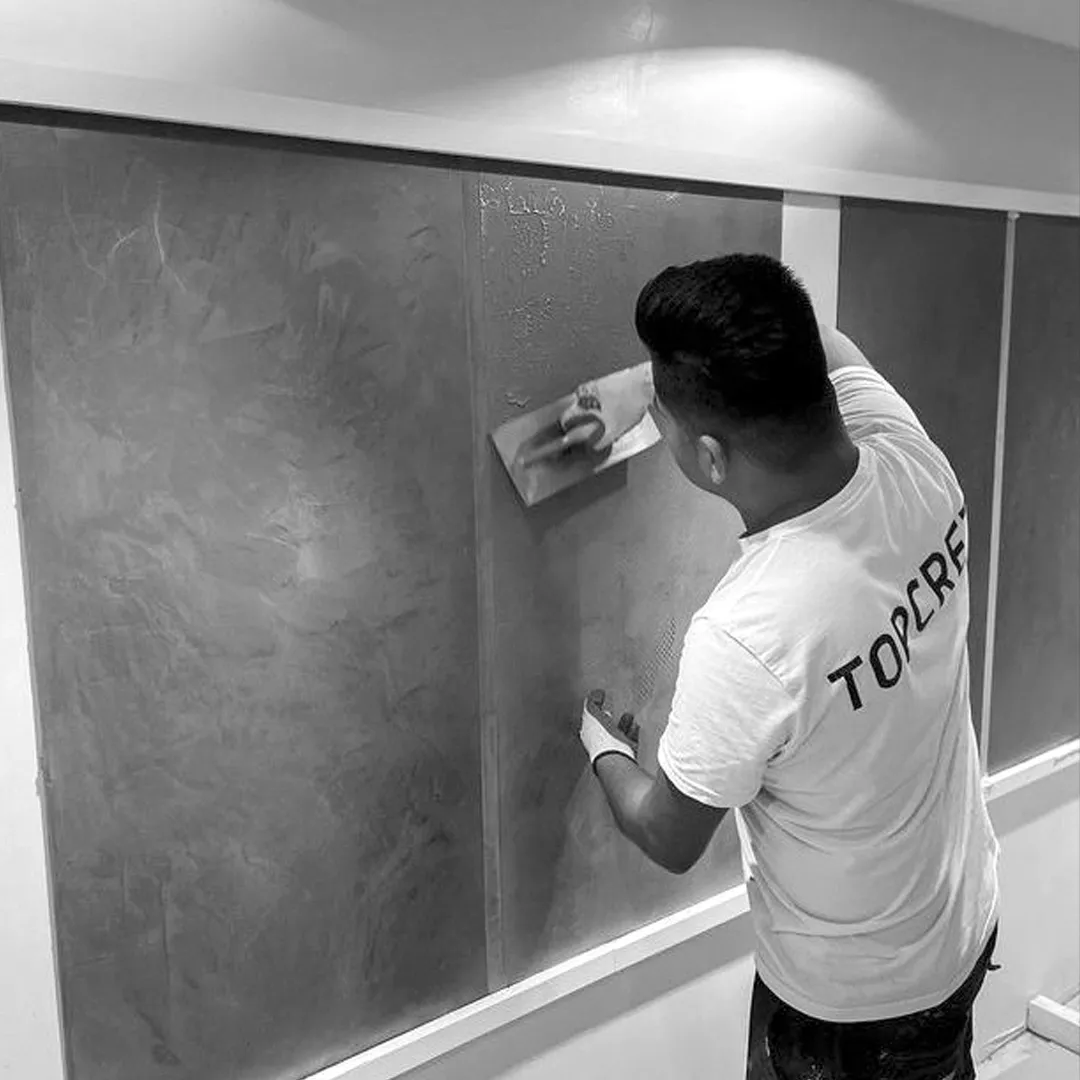
In short: yes, microcement can usually be repaired. Worn sealer and surface stains are fixed by cleaning and resealing; chips are filled and blended; cracks are opened, stabilised and rebuilt, but only once the movement behind them has stopped. Small patches can show, so repairs are often taken to a natural break. If Topcret installed it, start with the guarantee.
- Most common fix: cleaning and resealing a worn surface
- Chips and scratches: filled, blended and resealed by an applicator
- Cracks: repaired only after the cause (movement, damp) is sorted
- Widespread damage: resurfaced over the top, without demolition
- Topcret installations: three-year written guarantee on product and application
What's wrong with my microcement? A quick diagnosis
| What you see | Likely cause | What to do |
|---|---|---|
| Dull, patchy areas in walkways or by the sink; water soaks in | sealer worn through | deep clean and reseal, an applicator job |
| Rings or marks that won't wipe off | stains through worn sealer, or acidic cleaners | clean, light sanding and reseal |
| Pale marks on shower walls | limescale from hard water | pH-neutral cleaner and a squeegee; never acidic descalers |
| Small chip on an edge or worktop | impact | fill, blend and reseal |
| Fine hairline crack that isn't growing | small movement in the base, or shrinkage | open, fill and seal; check it stays stable |
| Crack that follows a straight line | a joint in the base: between boards, tiles or old and new screed | reinforce the joint with mesh and rebuild the area |
| Crack that keeps growing or reappears | ongoing movement in the structure | find the cause first; a surface repair won't hold |
| Bubbling, peeling or white bloom | moisture coming up from below, or an incompatible sealer | investigate damp before any repair |
Most of the causes, and how they are avoided in the first place, are in microcement problems.
Repair or resurface?
A local repair is enough when the damage is limited to one area, any crack is stable, the base underneath is sound and the original system is known, ideally with the same colour and products.
Resurfacing is the better option when cracking is widespread, the colour of a repair would never blend in, the surface was installed with incompatible products, or the look has simply aged. Resurfacing still doesn't mean demolition: once the base is stable, a new microcement system goes straight over the old one, adding only a couple of millimetres.
How professionals repair microcement
Worn sealer and stains
The most common "repair" is really maintenance. The surface is deep-cleaned, lightly sanded to key it, and given fresh coats of finishing varnish. Stains that sit in the varnish usually come out with it; stains that have reached the microcement may need a light skim of colour first. More on sealing: microcement sealer.
Chips and scratches
The damaged area is cleaned, filled with matching microcement, sanded flush and resealed. Because microcement is coloured all the way through, a light scratch often shows the same colour underneath and only needs the sealer renewing.
Cracks
A crack is a symptom. The applicator first checks why it appeared: a joint in the base, a floor that flexes, a new extension that has settled, damp. Only when the cause is dealt with is the crack opened, cleaned, filled with a flexible repair product, bridged with reinforcing mesh and rebuilt in layers before the finish coats and sealer go back on.
Matching colour and texture
This is the hardest part. Microcement is trowelled by hand, so every surface has its own texture, and colours change slightly with light and age. A small round patch in the middle of a floor is almost always visible. Good applicators blend repairs over a wider area, or take them to a natural break, such as a doorway, a wall or the edge of a worktop, so the eye doesn't catch them.
A practical tip: keep the colour name or Paint To Sample reference of your microcement, and the name of the applicator who installed it. It makes any future repair much easier to match.
What you can do yourself, and what you shouldn't
Safe for homeowners:
- Clean with water and a pH-neutral soap; avoid bleach, ammonia, acidic descalers and abrasive pads.
- Squeegee shower walls in hard-water areas.
- Put felt pads under furniture and a mat at the garden door.
- Do the water-drop test to see if the sealer is still working.
Best left to an applicator:
- Filling chips and cracks, which needs the right product and colour.
- Resealing, because the sealer has to be compatible with the original system.
- Anything involving movement or damp.
Shop-bought fillers and generic sealers rarely match the colour or bond properly, and a failed DIY repair usually leaves a bigger area to fix.
UK homes: where problems usually start
- Old timber floors. Victorian and Edwardian suspended timber floors and parquet move too much for microcement. If it was laid straight over boards, cracks along the board lines will keep coming back; the lasting fix is a rigid base. Topcret doesn't apply over wooden floors.
- New extensions. A new slab or screed needs to dry and settle. Microcement laid too early can crack where the extension meets the old house.
- Underfloor heating. It is compatible, but the heating has to be switched off before installation and brought back up gradually afterwards. See microcement with underfloor heating.
- Damp. Solid floors without a damp-proof membrane, common in older houses, can push moisture up and lift the finish.
Microcement installed by someone else
If your microcement wasn't installed by a Topcret applicator, it isn't covered by Topcret's guarantee, and the products may not be compatible with a local repair. In many cases the most reliable solution is to stabilise the base and resurface the area with a complete Topcret system. An applicator can assess it on site.
If Topcret installed it: start with the guarantee
Topcret guarantees the product and its application in writing. Under its Guarantee and Insurance Programme, defective material is repaired or replaced at no cost for three years, on jobs carried out by a Topcret-trained applicator. If you think there is a defect, contact the applicator who did the work or our UK team.
How long does a repair last?
On a stable base, with compatible products and correct sealing, a repaired area performs like the rest of the surface. A repair over an unresolved cause, such as a floor that still moves or rising damp, will fail again whatever product is used.
Get it looked at
Our UK base is at Unit 4, 224 Iverson Road, London NW6 2HL; call +44 20 7624 2180.
Topcret works with certified applicators in London, Birmingham, Leeds and Manchester. Elsewhere in the UK, send us your postcode.
FAQs
Can microcement be repaired?
In most cases, yes. Worn sealer is renewed, chips are filled and blended, and stable cracks are opened, reinforced and rebuilt. Widespread damage is resurfaced over the top without demolition.
Why has my microcement cracked?
Usually because the base moved: a joint between boards, tiles or screeds, a floor that flexes, a new extension settling, or damp. The crack has to be traced to its cause before it is repaired.
Will a microcement repair be visible?
A small patch often is, because every surface is hand-trowelled. Applicators blend repairs over a wider area or take them to a natural break, like a doorway or the edge of a worktop.
Can I repair microcement myself?
You can clean, protect and test the sealer. Filling chips and cracks and resealing are best left to an applicator, because the products must match the original system and colour.
How much does microcement repair cost?
It depends on the damage: resealing a worn floor costs far less than rebuilding a cracked area, and resurfacing is priced like a new installation, at £85–£150 per m² installed. An applicator will quote after seeing it.
Is microcement repair covered by the guarantee?
On Topcret installations, defective material is repaired or replaced at no cost for three years under Topcret's Guarantee and Insurance Programme.
Request a quote
Tell us about your project
A few quick questions and we will get back to you with a tailored proposal.
Email or call us
The quote form needs JavaScript. You can also contact us directly:
A rough figure is fine.
Optional
Where are you based?
Your handle or a link to the profile.
Your contact details
Last step: we will email or call you with our answer.
Please wait a moment…
Preview: the HubSpot form is embedded here. No data is sent in this demo.
We could not load the last step
Email or call us and we will get back to you all the same:
Thank you for your interest
We have received your enquiry. A Topcret advisor will be in touch with you very soon.
Preview complete
This is a demo: no data was sent and nobody will receive this enquiry.
Discover our Colours
Our colourist experts developed more than 30 base colours to fulfill a wide range of applications. But we don’t want to limit your imagination, so we created Paint To Sample, a Topcret® innovation powered by your imagination, to offer high-end, enhanced personalisation for customers.
Our ISO certification process assures zero colour deviations, so what our client dreamed is what they will see installed in their project.
- Over 30 base colours available
- Colour on demand
- Finishes in several textures
In today’s world our connection with nature holds immense importance, and it is this bond that inspires our colours.
Application process
Surface preparation
Clean, dry and free of dust or grease. Any existing damage is repaired to guarantee a smooth surface.
Primer application
It creates an ideal bonding surface and can be tinted to match the colour of the microcement.
Mixing
It is mixed with water and the chosen pigments until the colour and texture are right.
First coat
Applied in a thin layer, left to dry before the second application.
Second coat
Slightly thicker than the first, this is the one that creates the texture and the finish.
Sealing and finishing
A sealer protects the surface from stains and damage; a finishing wax or oil sets the final look.
Success Stories
Real projects, real results.










What our clients say
- Topcret helped me doing a repair on my existing floor, and went the distance to get a good result. I would definitely use them againGillian D.★★★★★ (opens in a new tab)
- Jack and the team at Topcret were top-draw. We're beyond pleased with the finished look, but also very impressed with the experience. From our 1st meeting to the aftercare, Topcret were nothing but professional, knowledgable, friendly and flexible. Highly recommend.Sam S.★★★★★ (opens in a new tab)
- Topcret and Juan in particular went above and beyond. Juan worked long days to finish the project as soon as possible, and used his technical knowledge and expertise to problem-solve some of the issues we had with previous tradesmen's mistakes. So happy Topcret could match the paint colour we wanted and that the result is more of an even finish than the typical microcement mix of shades (which they can do as well - we just didn't want that look). Delighted with the result and would definitely use them again. Thank you so much!Isabel D.★★★★★ (opens in a new tab)
- We had our kitchen and bathrooms done in our house in Sydney. The team was very friendly and efficient and the end result was exactly what we wanted. Can’t recommend them enough!Carolina R.★★★★★ (opens in a new tab)
- Topcret’s attention to detail and overall quality of their work is exceptional. I am pleased with the results and would highly recommend Topcret to anyone in need of their services.Rodrigo T.★★★★★ (opens in a new tab)
- Jack has been incredibly helpful in answering all my inquiries since I’ve first visited the showroom. He also made sure that all the technical queries that were put forth from the architects were addressed and proposed solutions to better fit the material. I couldn't be happier, and would recommend 100%.Liza M.★★★★★ (opens in a new tab)
- I recently hired Topcret to finish the renovation on my kitchen and couldn’t be happier with the results. The transformation they've made is just incredible. Provided high quality work with great attention to detail. I would recommend Topcret to anyone looking to make their spaces more attractive!Francesco N.★★★★★ (opens in a new tab)
- Love the product and great customer service. I decided to go for a warm terracotta and Top Cret were very happy to accommodate to develop my own colour.Jacqui P.★★★★★ (opens in a new tab)
- Really happy with the quality of work Topcret have provided for my home. They did 2 Bathrooms, floors and walls which were finished in just 3 days. Jack was extremely helpful throughout the process, answering the many questions I had for him. Great product/ service, I will be recommending to everyone.Tommy J.★★★★★ (opens in a new tab)